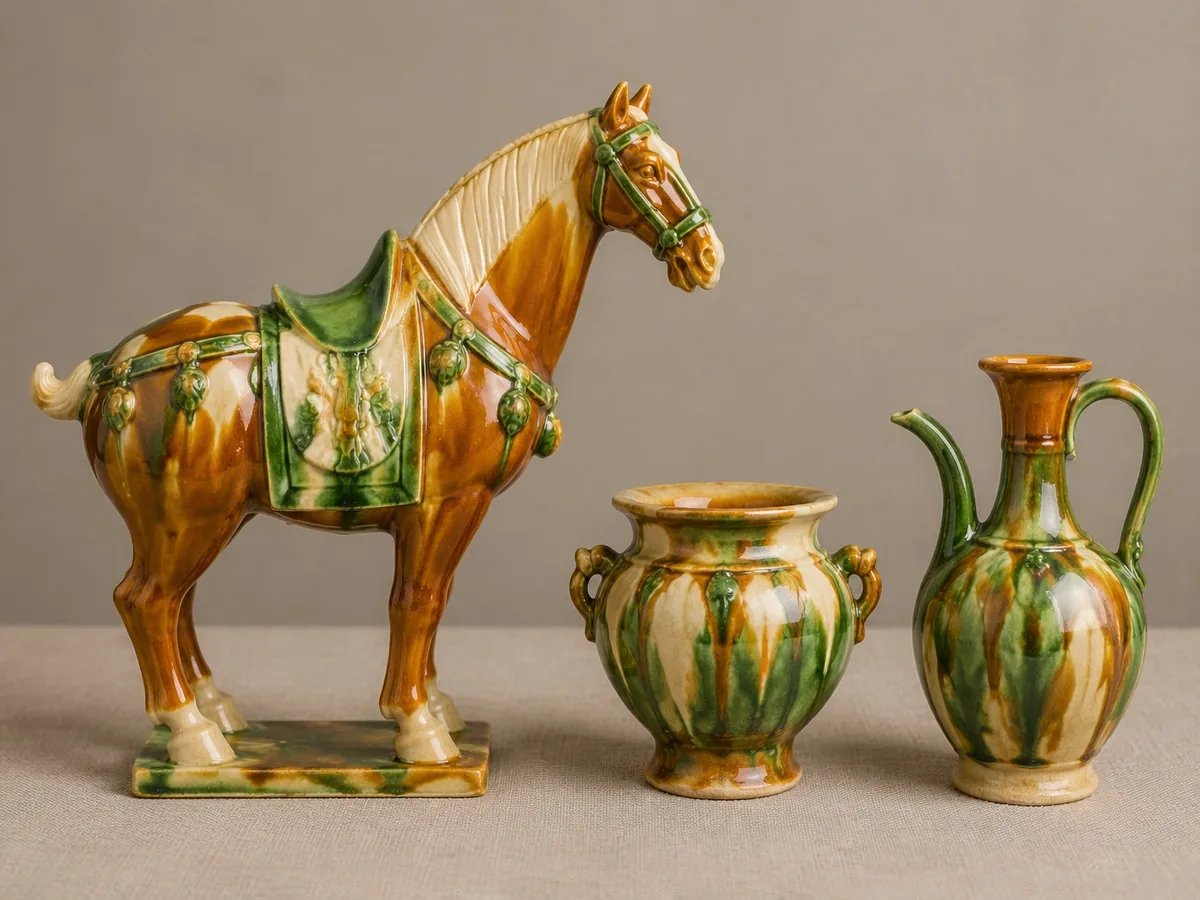
Tang Dynasty Horse Sculpture
Hand-modelled in Luoyang and fired with sancai glazes — amber, straw and leaf green. The horse is the defining form of Tang ceramic work, and this is the city it came from.
Why the Horse
The Tang dynasty is the period Chinese ceramic horses are known for, and Luoyang was one of its capitals. Of the nineteen documented horse forms in the Luoyang workshop repertoire, thirteen belong to this line.
The Tang horse is not a portrait of one animal. It is a type: the neck arched, one foreleg raised, the saddle cloth laid on, the mouth open as if calling. Some carry a rider; some are shown with the mane dressed into three plaits — the "three-flower" mane, a mark of the well-kept horse.
Typical Specifications
- Height
- 10–53 cm; most display pieces 30–43 cm
- Length
- 8–55 cm
- Body
- Low-fired earthenware, hand-modelled
- Glaze
- Lead-fluxed sancai: amber, straw and leaf-green
The Horse Head
A separate form in the repertoire: the head and neck alone, cut at the chest, mounted on a stand. It is the version of the Tang horse most often used as a desk or shelf object, and it reads well at small scale.
Craft & How to Tell It Apart
Hand-modelled or moulded?
Hand-modelled pieces carry irregular tool marks and slight asymmetry. Moulded pieces are even in the wall and identical across a run. Both exist; the difference is stated in the grade.
Reading sancai glaze
Sancai glazes are translucent and run in the kiln. Where the glaze has pooled you can see the colour deepen. A painted imitation is flat and stops at a hard line.
Earthenware or porcelain?
Sancai is a low-fired earthenware body — softer, warmer in tone, and it rings dull when tapped. Porcelain is denser and rings clear.
Replica, not original
Everything we sell is made now, by hand. It is a replica after Tang forms. Nothing on this site is an excavated object.
Proportion & Form
Two figures can be the same size, the same glaze and the same grade, and still not be equally good. What separates them is proportion — and proportion is the part of a Tang horse that is hardest to copy.
The body
A Tang horse is long in the barrel and short in the leg, with a deep chest. It is a stocky animal, not an elegant one. A figure that has been slimmed down to look more refined has drifted away from the Tang type rather than improved on it.
The neck and head
The head is small in proportion to the body and carried high. On a well-modelled figure the line from the chest, up through the neck and out to the muzzle reads as a single curve.
The legs
The legs are short and near-straight, tapering to the hoof. They are the thinnest part of the piece, and the part most often over-thickened so that it survives firing and shipping — which changes the silhouette.
The stance
A standing figure should sit level on its own base, all four feet in contact, with no rocking. Whether it does is a fair test of how the model was made.
Consistency across a run
On an order of several figures, what matters is that the run matches — the same stance, the same height, the same glaze family. Glaze will vary from piece to piece. Form should not.
Proportion here is not a matter of taste. The Tang type is documented, and a figure either follows it or it does not. If you are buying against a reference — a photograph, a drawing, or an object already in a collection — tell us at enquiry stage and we will tell you how close the model can be taken.
Placement & Meaning
In Chinese interiors the horse is placed near the entrance or in a study or office. The association is with momentum and advancement — the idiom 馬到成功, "the horse arrives, the task is accomplished".
On a desk, a horse head or a small standing figure is the usual scale. In a hallway or reception space, a larger horse on a plinth carries the space.
Placement conventions are a matter of taste, not prescription. We mention them because buyers in some markets ask, and because they are part of how the object is understood.
Buyers often ask what a Tang horse is worth. That question has two very different answers depending on whether the piece in front of you is an excavated original or a modern replica — and telling them apart is a skill in itself.
We have written a separate guide on identification and valuation.
Custom Work
Form — a standing horse, a horse with rider, a horse head, or a form you supply as reference. Glaze — the standard sancai palette, or a colour direction agreed with the maker. Base — none, a wooden stand, or a plinth. Presentation — export carton, retail box or branded case. Sampling — a sample is made before the production run so you can approve the glaze.
Care & Handling
Sancai is a low-fired earthenware under a glass glaze. It is durable, but it asks for different handling from porcelain. If you are reselling, these are the points worth passing on to your own customers.
- Keep it out of sudden temperature change. Do not move a piece straight from a cold store into a warm room, and do not leave it in a closed vehicle in the sun.
- Dust with a soft dry brush. Do not soak earthenware, and do not use abrasive or acidic cleaners on the glaze.
- Set the piece on a felt or cork pad. The glaze is glass, and the base is often left unglazed and slightly sandy — both will mark a polished surface.
- Lift a standing figure under the belly and the base together — not by the head, and not by one leg.
- Pack by material, not by box size. On a horse, the legs and the raised head are the parts that break.
Request a Quote
Tell us the craft line, the form, the quantity and the destination. We will come back with a quotation, lead time and packing details for your specification.