Marbled Sancai — Neriage & Agateware Pottery
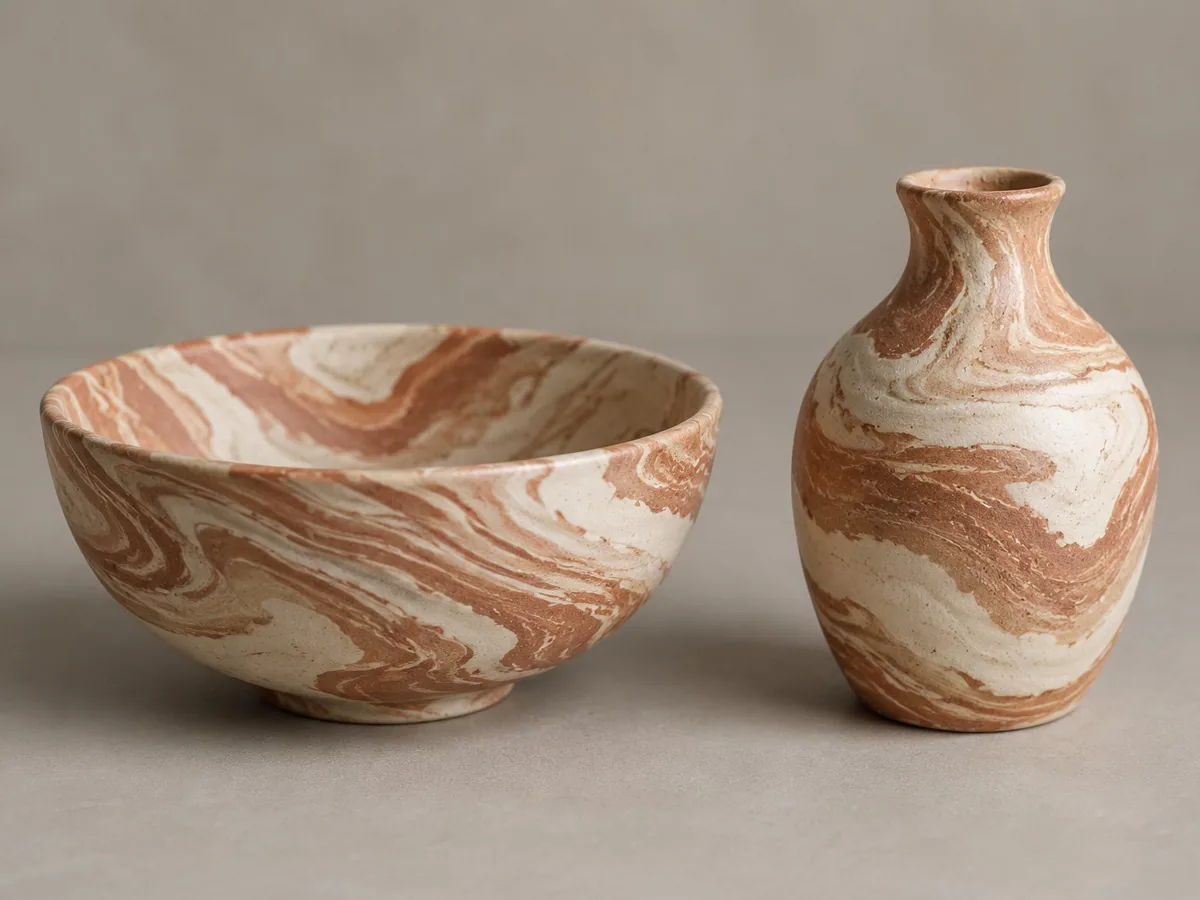
Two clays of different colours are wedged together so the pattern runs through the body of the piece. Cut a section and the pattern is still there. Nothing is painted on the surface.

Pattern Inside the Clay
Most decoration is applied to a surface. Marbling is not. Two clays — one coloured with a metal oxide, one left plain — are layered, folded and wedged until the pattern is distributed through the whole mass. When the piece is formed, the pattern is already inside it.
In China the technique is associated with Tang ceramics and with the Gongxian kilns; in Japan it developed separately as neriage, and in English it was historically called agateware, after the stone it resembles.
Cut a marbled piece in half and the pattern continues through the section. That is how you tell it apart from a painted imitation.
Craft Grades
Every line is graded the same way: by how much of the work is done by hand, what it is made of, and how the finish is treated. The grade is stated on your quotation so you know exactly what you are buying.
Pricing depends on size, craft grade and order quantity. Request a quote for your specification.
Hand-built
The form is made by hand throughout — thrown, modelled or built up.
Hand-finished
The form may be press-moulded or cast, but all finishing, carving and decoration is done by hand.
Studio grade
Hand work on a controlled form, with the maker's own glazes or patinas.
Presentation grade
The highest hand-work content in the line, selected for finish and consistency. Intended for gift and collection channels.

Typical Specifications
- Height
- 3.5–20 cm
- Diameter
- 5–20 cm
- Body
- Two clays wedged together; the pattern runs through the body, not on it

Custom Work
Clay pairing — colour combinations to your direction. Form — thrown, slab-built or press-moulded. Finish — clear glazed or left matte.
Request a Quote
Tell us the craft line, the form, the quantity and the destination. We will come back with a quotation, lead time and packing details for your specification.